Home

June 1, 2011

Germany hardsells Eurofighter jet for IAF

(IBN Live) : India and Germany called for reforms in the United Nations Security Council (UNSC) to reflect the changing world realities and power equations. Eyeing the $10.4 billion deal to supply 126 medium multi-role fighter aircraft (MMRCA) to India, German Chancellor Angela Merkel also tried to hard sell the Eurofighter Typhoon fighter jet, claiming that it was the best plane on offer.
"With the Eurofighter we have made good proposals and want to intensify our relationship with India. The Eurofighter is the best product on offer. We will not exert any influence on the procurement process and we shall wait and see," said Merkel while addressing a joint press conference with Prime Minister Manmohan Singh in New Delhi on Tuesday.
India and Germany also agreed to jointly tackle terror and find a solution to the Afghanistan problem with Merkel admitting that the challenges being faced in Afghanistan were "serious".
Singh said that he had wide-ranging discussions on various issues of mutual interest with Merkel including terrorism, the situation in Afghanistan, defence deals and nuclear energy.
"We reviewed developments in Afghanistan and terrorism. Terrorism has to be fought on all fronts and not selectively. We will also be in touch on UNSC reforms," said Singh.
Merkel backed India's demand for reforms in the UNSC to reflect the changing global order.
"The reform of UNSC is very necessary and it is good that Germany and India can work on that. We are seeing how we can align our policies to bring the reforms. The current UNSC does not reflect realities. We should focus our energies on speeding up the reform process," Merkel said
Singh said that UNSC still represented the world of 1945 and needs to be reformed soon.
"Germany and India are members of G4. We have been arguing for a long time that the composition of UNSC and its methods of working need to be updated in line of realities because the world of 1945 is non existent and current realities need to be taken into account. I hope our partnership in this task endures," said the Indian Prime Minister.
Singh said that situation in Afghanistan cannot have a military solution and world powers need to find a lasting solution.
"I already said India and Germany have same goal in Afghanistan, as an independent country with security in its hands. We do not think a military solution alone is possible and a security architecture is needed. An Afghanistan conference with focus on transition and reconciliation is a part and parcel of this," he said.
Singh mentioned that India needed nuclear power to meet its growing energy demand. He said that India must raise the share of nuclear power which will also help to meet its emission targets.
"Nuclear energy accounts for only three per cent of total energy generated in our system. As of now our capacity is less than 5000 MW. We want to raise it to 20,000 MW by 2020. If India is to meet its emission targets then nuclear energy and emphasis on renewable energy is required. We must have the option of make use of nuclear energy together with coal," he said.
Singh added that though there was no discussion on a new chief for the International Monetary Fund but he made it clear that the best available person regardless of nationality should be selected to head the body.
India and Germany also signed four agreements for cooperation in vocational education, medical research and science and technology on Tuesday following talks between Singh and Merkel.
Earlier, Merkel's visit was delayed as Iran temporarily denied her plane overflight rights during her flight to India. The plane reportedly had to circle over Turkey for two hours before it was given permission to enter the Iranian airspace.

CCS to discuss defence deal with US

(PTI) The Cabinet Committee on Security (CCS) will discuss country's largest ever defence deal with the US for inducting 10 C-17 heavy-lift aircraft in its meeting expected to be held tomorrow. The USD 4.1 billion deal will be put up before the CCS for discussion, sources said here. The proposed deal through the Foreign Military Sales (FMS) route has been hanging fire for long with India seeking several clarifications from the manufacturer Boeing. The proposal to be considered by CCS would include offsets proposals worth 30 per cent of the total value of the deal and setting up of defence facilities in the country, they added.Under the procurement procedure, offsets clause entails that a vendor winning a defence deal worth over Rs 300 crore has to reinvest at least 30 per cent of the worth of the deal back in Indian defence, homeland security or civilian aerospace sectors. Defence Ministry has already approved funds for procuring the aircraft in this fiscal, the sources added. Boeing, along with another US company Lockheed Martin, recently failed to qualify in the bid for 126 Medium Multi-Role Combat Aircraft (MMRCA) which IAF is acquiring.India is planning to procure the aircraft for augmenting its fleet which now comprises Russian-made transport aircraft Ilyushin-76 and Antonov-32. After finalising the initial deal for ten aircraft, the IAF is also planning to place orders for additional six aircraft.


IBN Live

May 31, 2011

German Defence Minister to meet Antony: fighter deal on agenda

(PTI) In the race for bagging the multi-billion dollar combat aircraft deal, German Defence Minister Thomas de Maizere will meet his Indian counterpart A K Antony here tomorrow.The German Defence Minister is part of the delegation led by German Chancellor Angela Merkel who will be discussing a range of issues with Indian Prime Minister Manmohan Singh."The two sides are expected to discuss ways to increase security cooperation and strengthen counter-piracy measures along with the Indian Air Force (IAF) deal to procure 126 Medium Weight-Multi Role Combat Aircraft (M-MRCA)," Defence Ministry officials said.Eurofighter Typhoon, built by four nations including Germany, is one of the two selected aircraft for the M-MRCA tender, including French Dassault Rafale.Hard-selling its aircraft, German Ambassador to India Thomas Matussek appreciated the "transparency and orderly manner" in which India had approached MMRCA deal and said Germany is prepared to share most modern technology with its Indian partners.India and Germany share a strategic partnership in the field of defence.In 2006, the two sides signed a Memorandum of Understanding (MoU) for the establishment of three bilateral working groups focusing on strategic and policy matters on military issues, cooperation between the armed forces, defence technology and defence business cooperation.

IBN Live

Decks cleared for purchase of 10 C-17s with offsets

(Indian Express ) : After considerable diligence and mathematics, India is all set to purchase 10 C-17 Globemaster strategic lift aircraft from US for $4.1 billion, with upfront offsets of $1.12 billion. The Cabinet Committee on Security on Wednesday will consider a revised proposal for purchase of C-17s which, for the first time, outlines the offsets including a High Altitude Engine Test Facility and Trisonic Wind Tunnel Facility valued at $510 million, for the Defence Research & Development Organisation.
India’s access to advanced technology air tunnel would be important as it has depended on Russian test facilities to evaluate the indigenous Kaveri jet engine, which was to be used in the LCA project.
The other half of the offsets, according to the proposal, would be shared between Hindustan Aeronautics Ltd for training and maintenance for the aircraft, Tata Consultancy Services for defence strategic communication systems and Defence Land Systems — a joint venture between Mahindra Group and BAE Systems — for armoured vehicles. 
The original proposal had talked of Boeing fulfilling its obligations under the Defence Procurement Procedure “as per policy” and hence, the offset was not stated. Under the DPP, any foreign company bagging contract worth over $300 million has to invest back at least 30 per cent of it into the Indian defence sector.
However, sources said, the C-17 offsets would cost India an additional 7-8 per cent in the total outgo on the purchase as the US has explained that it would be paying more for Indian offsets than it could have got the same services and products from other sources.
With this offset promise, decks have been cleared for the biggest-ever Indo-US defence deal under the American foreign military sales (FMS) programme, a direct government-to-government contract.
The four-engine Globemaster-III giant strategic airlift aircraft is capable of carrying a payload of almost 170,000 pounds and landing even at small forward airbases with semi-prepared runways and can transport tanks and troops over 2,400 nautical miles.

Russia delivers another batch of naval fighters to India

Russia's MiG aircraft maker delivered a new batch of five Mig-29K/KUB carrier-based fighters to the Indian navy in May, the company said.
"A flight training simulator and other technical equipment has also been delivered," MiG said in a statement on Monday.
The two countries signed a contract stipulating the supply of 12 single-seat MiG-29Ks and four two-seat MiG-29KUBs to India in January 2004. The contract is part of a $1.5-billion deal to deliver the Admiral Gorshkov aircraft carrier, currently being retrofitted in Russia for the Indian Navy.
India's first four MiG-29Ks and MiG-29KUBs officially entered service in February 2010.
In March 2010, Russia and India signed a $1.5-billion contract on the supplies of 29 additional MiG-29K Fulcrum-D carrier-based fighter jets to New Delhi. The start of the supplies is scheduled for 2012.
The contracts for the jets also stipulate pilot training and aircraft maintenance, including the delivery of flight simulators and interactive ground and sea-based training systems.
The Indian Navy has named its Mig-29K squadron the 'Black  Panthers' The fighters will be based at an airfield in the state of Goa on India's west coast until the Admiral Gorshkov joins the Navy under the name of INS Vikramaditya in early 2013.
The Vikramaditya is expected to carry up to 24 MiG-29K/KUB fighters. The future indigenous aircraft carrier Vikrant being built by India may also carry these aircraft.

 (RIA Novosti)

Russian sub joins NATO exercise for first time

A Russian Black Sea Fleet task force, led by a submarine is taking part in NATO naval drills off the coast of Spain, the Russian Defense Ministry said, the first time a Russian submarine has participated in any NATO exercise..
Bold Monarch is the world's largest submarine rescue exercise held every three years. This year's exercise, conducted on May 30-June 10 near the Spanish port of Cartagena, involves submarines, ships and aircraft from both NATO and non-NATO countries, including Russia.
"The Russian task force comprises the diesel submarine Alrosa, salvage tug Shakhtyor, auxiliary vessel KIL-158, and rescue vessel Epron," a Russian Defense Ministry spokesman said on Monday.
The Alrosa, a Kilo class diesel-electric submarine, will play the part of a "vessel in distress", stuck on the sea bed. Ships equipped with a range of sophisticated debris clearance, diver assisted gear and submarine rescue vehicles will attempt to salvage the sub and rescue its crew.
The Russian auxiliary vessel KIL-158 carries an advanced Seaeye Panther Plus underwater remotely operated vehicle (ROV), the spokesman said.
Panther Plus was adopted by the Russian Navy after an incident with Russian submariners in the Bering Sea in August 2005, when Russia's AS-28 submersible became tangled in a fishing net at a depth of about 190 meters (about 620 feet).
The ROV can operate at depths up to 1,000 meters (3,300 feet).

 (RIA Novosti)

Ukraine's economic news First batch of Indian Air Force An-32s upgraded in Ukraine leaves for India

(Interfax: Ukraine) Ukraine has sent a first batch of An-32 light transport aircraft to India following their upgrading at facilities of the Ukrainian defense and industrial complex under an order from the Indian Air Force.
Ukrspecexport state-run company told Interfax-Ukraine that first five ungraded planes have left for Kanpur (North India) from India. It is expected that the planes will arrive to India in 5-6 days.
Equipment to develop aircraft repair facilities in India was also shipped along with the aircraft.
"The contract is being realized according to schedule. India highly appreciates the quality of the work done by Ukrainian companies and new flying characteristics of upgraded An-32 aircraft," the company told Interfax-Ukraine.
By late 2011 another ten An-32 aircraft will be delivered to the customer, the company said.
The acceptance document for the first batch was signed by India on May 18.
The contract, worth some $400 million, involves repairing and modernizing 103 An-32 aircraft of Indian Air Force. It was signed in July 2009 between the Indian Air Force and Spectechnoexport, which won a respective tender announced in December 2007. Ukraine's Antonov Plant and Civil Aviation Plant 410 are executing the contract.
According to the contract, 40 airplanes are to be modernized in Ukraine and the rest of aircraft at the BRD-1 aviation plant of the Indian Air Force in Kanpur (North India).
As a part of the upgrade, the Indian aircraft will be fitted with around 25 types of modern equipment made in Ukraine and other countries. The equipment increases flight safety.
The upgraded An-32 will be able to land according to the ICAO category II approach. Fuel consumption and the mass of the empty upgraded aircraft will be lower compared to the basic model.
In addition, in line with a three-year contract worth $110 million signed in December 2009 by OJSC Motor Sich (Zaporizhia) and the Indian Air Force, the AI-20 engines of the Indian An-32s are to be upgraded.

May 30, 2011

SAAB to bid for Indian Navy MRMR tender

(StratPost) : Swedish defense and aerospace company SAAB is planning to offer its SAAB 2000 aircraft to the Indian Navy when it issues a Request For Proposal (RFP) for Medium Range Maritime Reconnaissance (MRMR) aircraft in the next few months.
The Indian Navy currently operates the Russian Tu-142 Bear and IL-38 aircraft, in addition to Dornier aircraft. It has also ordered eight P-8I Long Range Maritime Reconnaissance (LRMR) aircraft and is expected to buy an additional four.
The aircraft is built by US aviation company Boeing, which is planning to pitch a medium range 'diet P-8 for the Indian Navy’s MRMR tender.
While the SAAB 2000 is being offered with the RBS-15 Anti Ship Missile and a fifth generation Selex AESA radar, what is also interesting is that SAAB is offering re-manufactured aircraft, since the company ceased production of the aircraft in 1999.
“We will take an existing SAAB 2000. We will re-manufacture it and build it up. So it will be ground zero flying hours. We will have all the warranties. We will have 35,000 flying hours. It will have 25 years of support,” said Tommy Hultin, SAAB’s Business Development Director for the program.
Hultin also says the Harpoon missile manufactured by Boeing, which India is already planning to acquire for the Indian Air Force (IAF) Jaguar and the P-8I aircraft, can also be configured on the SAAB 2000, which he points out, is one of the fastest turboprop aircraft flying.

SAAB's offer
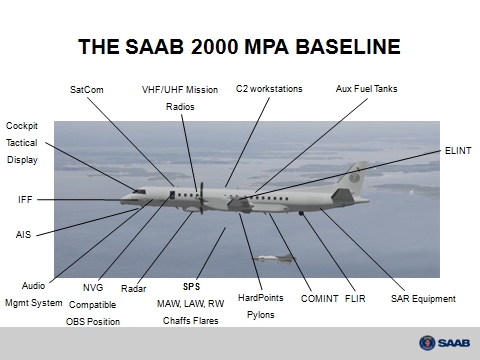
The baseline SAAB 2000
Radar: Selex Active Electronically Scanned Array (AESA) Maritime Surveillance Radar with long range search of 200 nautical miles. The interrogator functions of the Identification Friend-or-Foe (IFF) capability can be customized. The radar is paired with a Saab R4A AIS transponder receiver/transmitter system that marks maritime activity with an encrypted data link.
Electro-Optic (HDTV) and Thermal Imager sensors: For close range detection, identification and recording of surface objects and activities.
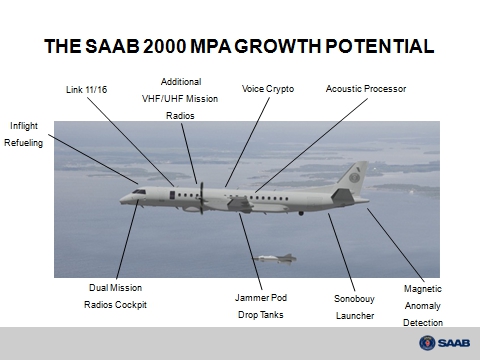
Growth options on the SAAB 2000
ELINT: Capable of intercepting and collect intelligence information consisting of detailed information of e.g. complex emitters active signal components, the relationship and the dynamics between active signal components.
ESM system: Automatically identifies RF (Radio Frequency) signal sources and Direction Finding of RF signal sources.
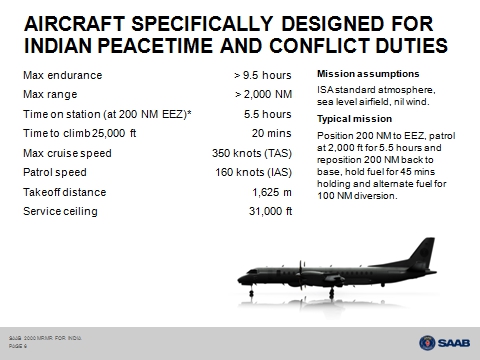
Specifications of the SAAB 2000
SPS system: Radar warning receivers, missile approach warning sensors, laser warning sensors as well as chaff and flare dispensers for self protection.
COMINT system: Enhances SIGINT capability by complementing the baseline ELINT system. Includes Direction Finder function and an Intercept System.
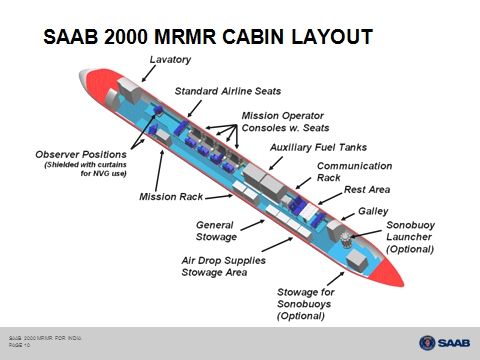
Cabin layout of the SAAB 2000
Command & Control (C2) system: Integrates and assists in controlling mission sensors and provides the user interface to mission operators, via four (4) workstations installed side-by-side in the cabin facing starboard, and to the pilots via a dedicated tactical display. The workstations also provide access to the mission communication system.
FLIR: Forward Looking Infra Red which can be used for identification of vessels. While performance depends on on environmental conditions such as fog, sea-state, salt percentage, it can typically be used within a range of 5-10 nautical miles.
SAAB says the aircraft can operate from high altitude airfields, ‘taking off with maximum load and fuel even at very hot temperatures’. With a cruising speed of 350 knots, it can climb to an altitude of 20,000 ft in 10 minutes and reach an operating area 1,000 nautical miles away within three hours. It can maintain position on a single engine even at a height of 20,000 feet.
The aircraft is said to be able to carry out a mission covering 200 nautical miles Exclusive Economic Zone (EEZ) for 5.5 hours at an altitude of 2,000 ft, or longer patrol times at higher altitudes up to 31000 feet.

West to have 80,000 cruise missiles by 2020 - interview

Russian military experts forecast that Western nations will have 80,000 cruise missile by 2020, a deputy commander of the Russian General Staff said on Saturday.
"We expect Western countries to have at least 80,000 cruise missiles by 2020, including about 2,000 of them nuclear-powered," Gen. Igor Sheremet said in an interview with the Ekho Moskvy radio station.
He added these missiles are clearly not simply designed for drilling or intimidation purposes.
"They can deliver disarming or even 'decapitation' strikes," Sheremet said.
Hence, he said, the plans to develop Russia's air and space defense system in 2011 as instructed by President Dmitry Medvedev in November.
The new system will combine the existing air defense and missile defense networks, missile early-warning systems and airspace monitoring systems under a unitified strategic command.
In mid-February, Valery Ivanov, commander of the strategic command of the new air and space defense system, said the system would be set up and start operating by the end of 2011.
The Russian political and military leadership have long considered plans to develop strong missile and space defenses by 2020, but no concrete steps have been taken so far and the country does not even have a well-defined command structure to tackle this problem.
According to one proposal, the unified aerospace defense command will absorb some air defense units which are currently part of the Russian Air Force, and Space Forces units.
The Russian military plans to build a comprehensive air and space defense network consisting of S-400 Triumf and future S-500 air defense systems and the Soviet-era Mig-31 Foxhound supersonic interceptors.
The S-500 system is expected to have an extended range of up to 600 km (over 370 miles) and simultaneously engage up to 10 targets. The system will be capable of destroying hypersonic and ballistic targets.
Russia's leading missile manufacturer Almaz-Antei said last March that it was developing at least six types of advanced air defense systems to be available for the Russian military in around 2015.
 (RIA Novosti)

Poland, U.S. to sign airbase deal after Obama visit

The Polish defense minister confirmed on Friday that Warsaw and Washington would sign a deal on the permanent deployment of a U.S. air detachment in Poland after U.S. President Barack Obama's upcoming visit to the European state.
Polish media reports have speculated that Obama could announce the transfer of an F-16 squadron from the Aviano base in Italy to the Lask air field in central Poland during his May 27-28 visit to Warsaw.
"An agreement on the permanent deployment of U.S. Air Force assets in Poland and the periodic rotation of F-16 fighters in the country will be signed after Barack Obama's visit," Defense Minister Bogdan Klich said in an interview with the TOK FM radio.
The U.S. detachment will service F-16 fighter jets, Hercules transport planes, and land personnel periodically visiting Poland, the minister said.
Klich expressed hope that the F-16 rotation could start as early as in 2013.
Meanwhile, Russia warned Poland against hosting U.S. fighter jets, saying it would counter the move.

 (RIA Novosti)

Student Innovative Ideas Ready to share most modern technology with India: Germany

(PTI): Appreciating the "transparency and orderly manner" in which the Indian government has gone about the selection of Medium Weight-Multi Role Combat Aircraft (MMRCA), Germany has said it is prepared to share most modern technology with its Indian partners.

Briefing reporters ahead of the Chancellor Angela Merkel's visit next week, German ambassador Thomas Matussek said in all probability she will express to the Prime Minister "our great satisfaction about the transparency and orderly manned in which Indian government approached this process".

She will also "express our full confidence in the procedure with which India, Indian Air Force (IAF) and Ministry of Defence (MoD) will continue to approach this process", Matussek said here.

Asserting that Germany was prepared to share most modern technology with its Indian partners, he said Germany was "quite happy" with its Eurofighter Typhoon's shortlisting.

Terming the development as a "unique, strategical and technological partnership", he said the Eurofighter represents the most advance and the most cost efficient combat aircraft.

He said these are the most modern aircraft, not the old ones which have been modernised many times.

Asked about competition from French fighter aircraft Rafale, developed by France’s Dassault Aviation, Matussek said, it was always better to go with a group of more than one country as it provides you with more expertise.

Developed by European Consortium's EADS, Typhoon along with Rafale last month qualified for the final round of commercial bidding process for the $10.4 billion MMRCA deal.

Under the deal, India would get a total of 126 fighter aircraft which will form the backbone of IAF's air-strike and deep penetration capability in the future.

(Brahmand)

Russia Snubs India

(India Today): Russia has cancelled both its 'Indra' series of military exercises with India. Last month, a flotilla of five warships from the Indian navy's eastern fleet that went for joint naval exercises to Vladivostok in the Russian far-east, was turned back without any manoeuvres. The warships-which included the missile destroyers INS Delhi, INS Ranvir and INS Ranvijay-were warmly received by the Russian navy, but when asked about the exercises, they were told the Russians had no ships to spare. On a request from the Indian fleet, a face-saving 'table top exercise or a land-based simulation, was carried out. What rubbed salt in their wounds was that Russian warships sailed out for an exercise of their own, apparently belying their earlier claims. The cancelled exercise was hushed up even as the warships returned to Visakhapatnam. A befuddled Ministry of Defence (mod) was groping for answers when they were snubbed again. Last week, Russia informed the mod that it had cancelled the upcoming joint army exercises scheduled to be held in Russia in June. One of the reasons given was that the mod had not informed Moscow of the army exercises in advance. Petr Topychkhanov of the Carnegie Moscow Centre says the cancellation of the exercises does not reflect any change in relations with India. "One of the reasons could be the hard process of military reform in Russia. The Russian armed forces are unready for an international exercise at this stage," he says.
Since 2003, India and Russia have conducted five of the Indra series military exercises between the armies and navies of both sides. The last such exercise was held between Russian and Indian army units in Uttarakhand in October last year. In sharp contrast, India has conducted over 60 military exercises with the US. Indian defence officials admit that exercises with Russia are largely symbolic but are an important barometer of healthy ties between the two sides. The strategic partnership with Russia still holds.
Defence Minister A.K. Antony says that Delhi's proximity to Washington will not be at the cost of ties with Moscow. On the ground, however, ties have been on a roller-coaster ride. Russia is unhappy at losing a lucrative $10 billion contract for 126 multi-role medium combat aircraft. The iaf narrowed its choice to France's Rafale and Europe's Typhoon, ejecting US and Russian contenders. Topychkhanov does not rule out cancellation of the military exercises as a retort by the miffed Russians. Air Chief Marshal P.V. Naik visited Moscow recently to inspect progress on the joint Indo-Russian Fifth Generation Fighter Aircraft (fgfa). The visit was also meant to mollify Russia and indicate India's commitment to the futuristic fighter which is expected to replace the most current fighter aircraft in the iaf's inventory when it is ready for squadron service in 2017.
Relations between India and Russia soured in recent years over the extended deadline for the refit of the aircraft carrier, Admiral Gorshkov. The refit slipped by four years and the its cost doubled to $2.3 billion. The carrier will now be delivered late next year. Deadlines for the acquisition of an Akula-II class nuclear-powered submarine have slipped by over three years. India paid $670 million for completing the submarine under a 2003 contract. This month, a 100-man Indian crew that had gone to Vladivostok to bring the vessel back returned empty-handed. There is no word on when the strategic submarine, which the navy desperately needs, will be transferred to India. Russia is reportedly keen that India pay for the completion of a second unfinished Akula hull at the Komsomolsk shipyard. This has been turned down by the navy.
The real issue is the poor sourcing of components for Russian-made equipment operated by the Indian armed forces. Over half the inventory of the three armed forces comprise equipment of Russian origin. "It takes nearly a year for us to get even export permissions from Russia. This severely impacts force preparedness," says a defence official.
Some of India's consternation over these delays may have spilled over at a meeting between navy chief Admiral Nirmal Verma and the visiting Russian navy chief, Admiral Sergeevich Vysotskiy, this January. Various department heads of the Indian navy read out the riot act on the poor serviceability of warships, aircraft and submarines to the Russian naval delegation. After the meeting, Vysotskiy privately conveyed his dismay at the ambush. The warning signs appeared at a recent joint meeting in Moscow when Russian defence officials refused to discuss military exercises. Evidently, it was a portent of the chill to come.