Home

May 18, 2022

India halts Ka-31 helicopter deal with Russia


 India has halted negotiations with Russia for the former to acquire 10 Kamov Ka-31 airborne early warning helicopters for $520 million, following uncertainties in arms supplies amid Russia’s invasion of Ukraine.

The Indian government indefinitely suspended the negotiations with Rosoboronexport and original equipment manufacturer Russian Helicopters, an Indian Defence Ministry official told Defense New on condition of anonymity. The official, who was not authorized to speak to the press, said the government-to-government deal added that the suspension is due to concerns over Moscow’s ability to execute orders as well as issues related to payment transfers.
Indian Navy officials have said the suspension represents a setback for the service because the Ka-31 helicopters are needed for the country’s second aircraft carrier INS Vikrant, which was locally built and will be commissioned in July.

Amit Cowshish, a former financial adviser for acquisitions with the ministry, said the suspension could also be due to geopolitical pressure as the international community condems Russia’s attack on Ukraine, which began Feb. 24. Other factors, he added, could include budgetary constraints and India’s preference to acquire locally developed helicopters.

And a stalemate in negotiations over technical and financial issues could have also played a role, he noted.
India asked to buy Ka-31 helicopters from Russia in May 2019, but the acquisition program faced inordinate delays due to the coronavirus pandemic and the platform’s high price tag.

Acquisition talks resumed in February 2022 after negotiators settled on a price of $520 million for 10 Ka-31 helicopters, but the effort hit another snag when officials couldn’t agree on a rupee-ruble currency mechanism.

The MoD official said India’s central bank, Reserve Bank of India, has worked overtime since March 2022 to establish an alternative payment mechanism, but negotiators have been unable to come to an agreement.

Neither ministry nor Navy officials would discuss whether India is exploring alternatives to the airborne early warning craft.

The Navy currently operates 14 Ka-31 helicopters, which were inducted progressively — four in 2003, five in 2005 and five in 2013 — and are dependent on the original equipment manufacturer for spare parts, repairs and overhaul support.

defensenews

Why China Is Paranoid About the Quad


 India may be nowhere near turning its partnership with the United States into any sort of formal or informal military alliance, but their growing strategic engagement dominates China’s discourse on India. Next week’s Tokyo summit of the Quadrilateral Security Dialogue, or Quad—a loose grouping of Australia, India, Japan, and the United States—is therefore bound to be of special concern in Beijing.

On the face of it, China’s persistent campaign against India’s ties with the United States, its characterization of the Quad as an “Asian NATO,” and its blistering attacks against the Indo-Pacific geopolitical construct embraced by New Delhi and its partners in the Quad seem unnecessarily alarmist. Its top diplomats have castigated the Quad members for “ganging up in the Asia-Pacific region, creating trilateral and quadrilateral small cliques, and [being] bent on provoking confrontation.” China focusing its outrage on the Quad looks odd considering Beijing has long lived with real U.S. alliances and hard security commitments on its periphery, including U.S. troops stationed in South Korea, Japan, and elsewhere.

Two factors, however, help explain China’s aggressive campaign against the Quad and, especially, nascent U.S.-Indian ties.

The most obvious factor is India’s sheer size and potential power to shape China’s strategic periphery. Although China has rarely seen India as a peer competitor, Beijing is acutely conscious that India could create significant problems for China if aligned against it with other powers. Keeping India—a potential superpower—from aligning with the United States is thus a first-order strategic goal for Beijing.
That China’s concerns about a potential U.S.-Indian alignment have recently taken a paranoid turn reminds us of Beijing’s endless rants about New Delhi’s strategic collaboration with Moscow during the 1960s and 1970s. Beijing worried about Russian imperialism aligning with India’s own hegemonic ambitions in South Asia. Chinese leader Mao Zedong was at his vulgar and pithy best in a poem describing the Soviet Union’s relationship with India: “The bear flaunts its claws / Riding the back of the cow.” Then, as now, China did not like to see India’s relations with other powers looking better than its own mostly failed attempts to win allies.
Second, Beijing is playing to the gallery of entrenched anti-American sentiment in New Delhi that insists on Asian solidarity and avoidance of Western coalitions. Although the weight of this sentiment—a product of India’s history of anti-colonialism, quasi-socialism, and Cold War alignment with the Soviet Union—has begun to decline, there are many in the Indian establishment who worry that getting too close to the United States might provoke China. Beijing is betting that its warnings might stoke further unease in New Delhi.

China, of course, has a much longer history of partnership with the United States, beginning under former U.S. President Richard Nixon in the 1970s. In New Delhi, on the other hand, keeping a reasonable distance from Washington has been a long-standing policy. Even as India warmed up to the United States in recent years, New Delhi has insisted that its policy of “strategic autonomy” remains unchanged—currently demonstrated by India’s refusal to join its Quad partners in denouncing Russia’s unprovoked aggression against Ukraine.

Beijing’s obsession with Indian-U.S. relations also stands in contrast to the fact that China has rarely objected to Pakistan’s intensive, formalized military partnership with the United States over the decades. China seems to have no issues reaching out to Pakistan despite the latter’s bilateral military cooperation agreement with the United States and former membership in the Central Treaty Organization and Southeast Asia Treaty Organization—two alliances sponsored by Britain and the United States, respectively, in the 1950s.

Despite occasional hiccups, the U.S. military partnership with Pakistan endured through the decades but drew little criticism from Beijing. When the United States declared Pakistan a major non-NATO ally in 2004, it evoked little protest from China—on the contrary, Beijing continues to celebrate its “all weather” partnership with Islamabad. This stands in sharp contrast to China’s ballistic rhetoric in 2007, when India invited Australia, Japan, and Singapore to join its annual Malabar naval exercises.
Beijing called the event the precursor to the formation of an Asian NATO. 

Chinese propaganda along these lines has had some measure of success in India in the past; the narrative of Washington trying to engineer an Asian NATO resonated with Indian nationalists and leftists who shared the Chinese idea that Asian security must be shaped by Asian powers. In September 2007, Beijing’s campaign against a U.S.-led Asian NATO triggered large-scale protests by the Indian communist parties and played a role in the eventual collapse of the coalition, backed by the left, supporting the Manmohan Singh government.

 foreignpolicy

US Seeks To Wean India From Russia Weapons With Arms-Aid Package


 The US is preparing a military aid package for India to deepen security ties and reduce the country’s dependence on Russian weapons, people familiar with the matter said.

The package under consideration would include foreign military financing of as much as $500 million, according to one person, which would make India one of the largest recipients of such aid behind Israel and Egypt. It’s unclear when the deal would be announced, or what weapons would be included.

The effort is part of a much larger initiative by President Joe Biden’s administration to court India as a long-term security partner, despite its reluctance to criticize Russia for its invasion of Ukraine, according to a senior US official who asked not to be named.

Washington wants to be seen as a reliable partner for India across the board, the official added, and the administration is working with other nations including France to make sure Prime Minister Narendra Modi’s government has the equipment it needs. While India is already diversifying its military platforms away from Russia, the US wants to help make that happen faster, the official said.The major challenge remains how to provide India major platforms like fighter jets, naval ships and battle tanks, the official said, adding that the administration is looking for a breakthrough in one of these areas. The financing package being discussed would do little to make those types of systems -- which can cost billions or tens of billions of dollars -- more affordable, but it would be a significant symbolic sign of support.

India’s Foreign Ministry didn’t immediately respond to a request for comment. Officials at the State Department and US embassy in New Delhi didn’t immediately respond to a request for comment.

India is the world’s largest buyer of Russian weapons, although it has scaled back that relationship of late. Over the past decade, India has bought more than $4 billion worth of military equipment from the US and more than $25 billion from Russia, according to the Stockholm International Peace Research Institute, which collects data on arms transfers.

India’s dependence on Russia for weapons against neighbours China and Pakistan is a big reason Modi’s government has avoided criticizing Russian President Vladimir Putin over the war in Ukraine. As the US, Europe, Australia and Japan piled economic sanctions on Russia, India has held off and instead continued imports of discounted Russian oil.Reliance On Russia

While the US and its allies were initially frustrated with India, they have sought to woo Modi’s government as a key security partner -- including against China in the Indo-Pacific region. Modi is set to join a summit with Biden next week in South Korea. The meeting will include leaders from the Quad, a partnership between the US, India, Japan and Australia that has drawn criticism from China. Modi also received an invitation to join the Group of Seven leaders in Germany next month.

Defence Secretary Lloyd Austin made the point about China when he spoke at a news conference in April with Secretary of State Antony Blinken, Indian Defence Minster Rajnath Singh and Foreign Minister Subrahmanyam Jaishankar.

“We’re doing all this because the United States supports India as a defence industry leader in the Indo-Pacific and a net provider of security in the region,” Austin said. “And we all understand the challenges that we face there. The People’s Republic of China is seeking to refashion the region and the international system more broadly in ways that serve its interests.”

Links between the US and India have steadily deepened over the past two decades, with the two sides reaching agreements that allow for more interoperability between their military platforms.

 indian defensenews

May 17, 2022

China Enhancing Infrastructure Near Arunachal Border, Says Army


 China’s People’s Liberation Army (PLA) is enhancing its capacities with infrastructure development across the Arunachal Pradesh border, Indian Army Eastern Commander Lt General RP Kalita said on Monday.

General Officer Commanding-in-Chief of the Eastern Command, Lt General RP Kalita, however, said the Indian side is also continuously upgrading its infrastructure and capabilities to deal with any situation which may arise along the border.

“Across the Line of Actual Control in Tibet region, a lot of infrastructure development is going on. The other side is constantly upgrading their road, rail and air connectivity so that they are in a better position to respond to a situation or mobilise forces,” he said at a presser.

The Chinese authorities have built border villages close to the LAC that can be used for dual purposes, Kalita said.

“We are continuously monitoring the situation. We are also upgrading our infrastructure and capabilities as well as the mechanism to handle the situation. These have put us in a robust position,” he added.

indiadefencenews

April 26, 2022

As threat grows, IAF seeks hand-held, one-man system to shoot down drones


Self-contained system should be man portable and be operable by a single person besides having a range greater than 300 metre and capable of repeated use in quick succession
Amidst growing threat posed by unmanned aerial systems (UAS), the Indian Air Force has chalked out a requirement for a hand held, easy to use system that can shoot down rouge drones.The sixth edition of Defence India Startup Challenge (DISC-6), launched by the Defence Minister on April 22, calls upon the industry to develop a hand held, hard kill, counter-UAS system. DISC is a platform under the aegis of the Ministry of Defence that offers specific projects to the industry, particularly start-ups, to develop technological solution and products for the armed forces.

According to parameters listed in the document, the self-contained system should be man portable and be operable by a single person besides having a range greater than 300 metre and capable of repeated use in quick succession.Further, it should not require any special skills and training for neutralizing the drone and the provision of aiming and neutralising should be very simple and achievable with minimum training.

The system is meant to intercept and destroy small low flying drones that have miniscule radar, thermal or acoustic signature and are primarily used for surveillance and cross border smuggling or can be used to carry out a terror strike, as was experienced at the Pathankot airbase in Punjablast year.
Punjab and Jammu regions remain vulnerable. 

According to data available with the Border Security Force, there were 100 drone sightings along the western border in 2021, out of which 67 were in Punjab followed by 24 in the JammuSector. This year there havealready been over half a dozen engagements with drones, with some reports claiming that an IED that exploded nearJammu on the day of Prime Minister Narendra Modi’s rally is believed to have been dropped by a drone.

While the capability to detect and counter large unmanned aerial vehicles exits, detection of small drones is very difficult and at present depends primarily on visual sightings or audio hearing. Troops engage small drones with standard rifles, which is difficult.Two basic options to neutralize drones are the soft kill, which relies on jamming or hacking the target drone’s radio signals, or the hard kill which requires the drone to be physically destroyed by ordnance or lasers.

The armed forces as well as paramilitary and police organisations are laying great stress on the induction of anti-drone systems. Besides procurement of some foreign systems, several projects are underway to develop different indigenous systems to counter various types to drones.Over the past few years, there have been several reported instances where drones have been used to smuggle arms and ammunition as well as narcotics into India. Employment of drones for surveillance and recce in border areas is also a regular feature. Border guarding forces have been modifying their operating procedures to tackle hostile drones.

 tribuneindia

Boeing plans to fly 2 Super Hornet aircraft to India; All you need to know


Boeing is in talks with top Defence officials in the country about F/A-18 Super Hornet, P-8I, F-15EX, KC-46 tanker as India plans to boost its defence capabilities.

 Boeing is planning to fly two Super Hornet fighter aircraft for an operational demonstration to Goa before its potential buyer the Indian Navy this summer. According to the news agency PTI, Boeing's India Business Development Alain Garcia made a strong sales pitch for F/A-18 Super Hornet. Gracia said the Super Hornet aircraft has been specifically designed from its inception for carrier operations, can operate from the Indian Navy aircraft carriers, and will meet or exceed the STOBAR performance requirements of the Indian Navy.

 STOBAR (short take-off but arrested recovery or short take-off, barrier-arrested recovery) is a system used for the launch and recovery of aircraft from the deck of an aircraft carrier.

Boeing is in talks with top Defence officials in the country about F/A-18 Super Hornet, P-8I, F-15EX, KC-46 tanker for aerial refueling and ISR capabilities as India plans to boost its defence capabilities.


Boeing's F/A-18 Super Hornet;


1. According to a senior Boeing executive, the Super Hornet is suited to protect India's maritime interests. He said the Super Hornet and P-8I will open up opportunities for greater interoperability between the two navies for a secure Indo-Pacific.

2. The Block III Super Hornet comes with advanced networking and open architecture design that allows it to work jointly with the Indian Navy's P-8I and other US-origin assets and rapidly accept new technology to stay ahead of emerging threats

3. The US Navy operates more than 800 Super Hornets and EA-18 Growlers, the electronic attack version of the F/A-18.

4. Super Hornet F/A-18E weighs 14,552 kg, with a maximum takeoff weight of 9,937 kg. It flies at Mach 1.6 speed, which means 65% faster than the speed of sound. At present, the US, Australia, and Kuwait have F/A-18 Super Hornet customers.


The Super Hornet has an affordable acquisition cost and also costs less per flight hour to operate than any other tactical aircraft in the US forces inventory, including single-engine fighters.

Maria Laine, vice president of Boeing's International Business Development, said that India is one of Boeing's enduring partners where "we have made strategic investments and will continue to do so in the future".

The company has 3,500 employees in India and more than 7,000 people working with its supply chain partners.

"We are proud to support the many missions of the Indian armed forces that operate multiple Boeing aircraft...," she said.

“In support of Aatmanirbhar Bharat and Make in India, Boeing sources over USD 1 billion from India, and Boeing's Indian supply chain partners are exporting products made in India for the global aerospace market," the company said.

 Tata Boeing Aerospace Limited (TBAL), the joint venture between Boeing and Tata Advanced Systems, has been producing aero-structures for Boeing's AH-64 Apache helicopter and recently delivered its 140th AH-64 Apache fuselage from its 14,000 square metres state-of-the-art facility in Hyderabad.

TBAL is also manufacturing 737 Vertical Fin structures, a complex structural part, on a new production line that will utilize cutting-edge robotics and automation, said the Boeing official.

themint

April 4, 2022

Kashmir: Indian forces seal infiltration routes opened due to melting snow


Braving the harshest winter season on the Line of Control (LoC) in north Kashmir, Indian security forces have been guarding the border facing sub-zero temperatures. And now with the melting of snow on the higher reaches of northern Kashmir, the vigil on the traditional infiltration routes has been increased to foil any infiltration bids. 

The security forces have inputs that more than 350 terrorists are waiting across the border in various terror launch pads to cross over to the Kashmir Valley. Security forces also believe that a lot of 'fanatic warriors' from Afghanistan can be sent to Kashmir, but the forces are ready to tackle any such issue. All the high-ranking officers of Army and BSF are making special visits to LoC to take stock of the situation on ground zero.

"After the snow has started to melt on these higher reaches. We have increased the vigil on those areas which are prone to infiltrations. Our sources say that around 125-150 terrorists are waiting across the border to infiltrate. Army and Border Security Force (BSF) have made sure the terrorists are neutralised and situation is very peaceful in the valley. There is a possibility of fanatic warriors trying to infiltrate from across the border," said Raja Babu Singh, Inspector General (IG0, BSF, Kashmir Frontier. 

The jawans guarding the border have been given all new technology equipment which include sophisticated weapons, surveillance cameras with night vigil, drones and thermal imaging tracers. The patrolling has also been increased across the LoC. 

wion

Indian Army inducts Russian Igla-S MANPADS


 The Army, which has for long been looking for new man portable air defence systems, has inducted a small number of Igla-S systems recently bought from Russia under emergency procurement, according to defence sources. However, a much larger contract for Igla-S systems under the Very Short Range Air Defence System (VSHORAD) deal is still pending and under review by the Defence Ministry.
“The contract was signed in December 2020 and the equipment was delivered by December 2021. This includes 24 launchers, 216 missiles and testing equipment,” one of the sources said.

The procurement was done through the Vice Chiefs emergency financial powers given to the Services for the first time after the Balakot air strike in February 2019 and further extended after the standoff with China in Eastern Ladakh in May 2020. Under this, Services can procure weapons systems upto ₹300 crores on an urgent basis without any further clearances.

In the backdrop of the Russian special military operation in Ukraine and the Western sanctions, India and Russia are working out modalities to utilise the Rupee-Rouble route in a large way for trade and payments. The Ministry is also assessing the impact it would have on the timely execution of deals as well as steady supplies of spares and supportThe larger VSHORAD deal which began in 2010 and saw several rounds of trials and re-trials is still pending.

This deal which was close to conclusion is now under review as part of the overall relook at all direct import deals by the Defence Ministry. Deliberations are still continuing on the larger VSHORAD deal, another defence source said.

The Request for Proposal (RFP) for VSHORAD was issued in October 2010 for over 5,000 missiles, 258 single launchers and 258 multi-launchers. Five contenders responded and eventually three made it to the trials - MBDA of France, Rosoboronexport of Russia and SAAB of Sweden. Eventually all three companies were declared technically compliant in 2017 and Igla-S was declared the lowest bidder in November 2018.

While the benchmark price arrived at by the Army was just over $2 bn, Rosoboronexport’s bid was much lower at around $1.47 bn, SAAB at about $2.6 bn, and MBDA at about $3.68 bn. This led to much deliberation within the Ministry as the Russian bid was much lower compared to the benchmark price. The deal also saw several allegations of deviations in procedures with some of the vendors sending protest letters..As per requirements, the VSHORAD should have a maximum range of 6 km, altitude of 3 km along with all-weather capability and will replace the existing Igla in service which is in urgent need of replacement. VSHORAD is the soldier’s last line of defence against enemy combat aircraft and helicopters in the multilayered air defence network.

In addition to the Igla-S, the Army variant of the Medium Range Surface to Air Missile (MRSAM) being jointly developed by the Defence Research and Development Organisation (DRDO) and Israel Aerospace Industries (IAI) completed trials earlier this month and is now ready for induction. The maiden launch of MRSAM Army Version was conducted in December 2020.

Air Defence functions in three levels – gun/missile system, medium range, and high range. Within this the Air Defence guns are of two types, AD Gun Missile system, AD self propelled guns. The Army is looking for AD guns in both the categories. In the medium segment, it has the indigenous Akash SAM while MRSAM fits in the high range.

The Hindu

April 1, 2022

Rafael Unveils SPIKE ER2 5th Generation Extended Range Missile - Video Footage

 SPIKE ER2 5th Generation Extended Range Missile


Russian Foreign Min Lavrov in Delhi, To Call on PM Modi & Meet Jaishankar Today


 Russian Foreign Minister Sergey Lavrov arrived in New Delhi on Thursday, 31 March – a day ahead of his interaction and meeting with Prime Minister Narendra Modi and Foreign Minister Dr S Jaishankar, respectively.

He is scheduled to meet Modi and Jaishankar today, as per Russian Foreign Ministry spokeswoman Maria Zakharova.

This is the first high-level visit from Russia since the country went to war with Ukraine.

The foreign minister was received at the airport by an Indian delegation, the Ministry of External Affairs indicated, posting a video on Twitter.
The visit comes even as the United States on Wednesday, 29 March, criticised India for attempting to undermine western sanctions by considering a trade proposal from Moscow. As per a Bloomberg report, which cites sources, Russia is offering huge discounts to India on its oil amid mounting sanctions from West.

Lavrov is expected to discuss Russia's crude oil offer to India, rupee-rouble payments, and arms deals during his visit.

His two-day-long visit will coincide with British foreign secretary Liz Truss's trip to India and US Deputy National Security Advisor for International Economics Daleep Singh's trip to India.

The Russian foreign minister is among the people sanctioned by the United States government.

 Thequint

March 29, 2022

"Target Destroyed, Direct Hit": India Test-Fires Surface-To-Air Missile


 "MRSAM-Army missile system flight was test fired from ITR Balasore, Odisha at around 1030 hours and intercepted a high-speed aerial target at long range," the DRDO said in a Koo post. Indian Army on Sunday successfully carried out the test firing of the Medium Range Surface to Air Missile air defence system off the coast of Odisha's Balasore, the Defence Research and Development Organisation (DRDO) informed today.

"MRSAM-Army missile system flight was test fired from ITR Balasore, Odisha at around 1030 hours and intercepted a high-speed aerial target at long range," the DRDO said in a Koo post.As per the DRDO, the target was destroyed by the missile in a direct hit.

NDTV

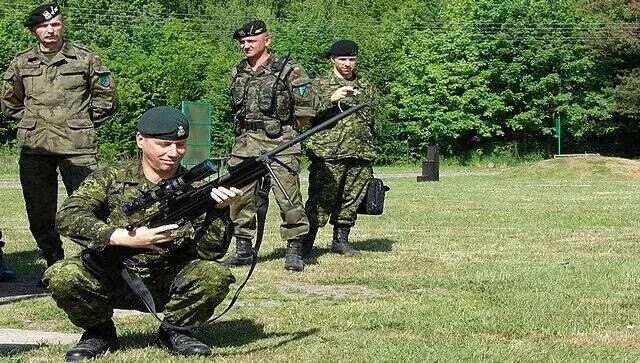
Indian Army gets Sako TRG-42 sniper rifles for soldiers deployed along LoC


  The Sako .338 TRG-42 sniper rifles, designed and developed by the Finnish gun maker SAKO, have a better range, firepower, and telescopic sights than those possessed by the adversary
The Indian Army has inducted the Sako .338 TRG-42 sniper rifles from Finland for soldiers deployed along the Line of Control (LoC) in Jammu and Kashmir, officials said.

"The latest sniper rifles have been inducted into the army. They are using it now, a senior official told PTI.

The Sako .338 TRG-42 sniper rifles have a better range, firepower, and telescopic sights than those possessed by the adversary, the official said.

The move is to make the snipers more lethal amid a change in operational dynamics along the LoC, the official said.
Sniping has been a bigger challenge for the troops patrolling forward areas along the LoC and the International Border (IB) in Jammu and Kashmir, said the official.

Between 2018 and 2019, there was a sudden increase in the number of sniping incidents along the LoC and IB prompting armed forces to induct better sniper rifles and train its snipers against such attacks.

The Sako rifles have replaced the .338 Lapua Magnum Scorpio TGT by Beretta, and the .50 Calibre M95 by Barrett, which were inducted in the Indian army in 2019 and 2020. These rifles, made in Italy and America, had replaced the ageing Russian Dragunov, the mainstay of Indian soldiers.

First procured in the 1990s, the Dragunovs have slowly fallen behind contemporary sniper rifles which offer improved sights and mounts, increased accuracy, and a strike range of over 1 kilometre.

The Sako TRG-42 sniper rifle is a bolt-action sniper rifle designed and developed by the Finnish gun maker SAKO.
The rifle is designed to fire powerful .338 Lapua Magnum-sized cartridges. and weighs at 6.55 kgs without ammunition. It has an effective range of 1,500 metres, the official said.

"It is considered one of the most accurate and trustworthy weapons worldwide, he said.

The Army has sanctioned a team of 10 snipers, selected from the Indian Army's units and regimental centres for the job, the official added.

firstpost

Huge 'Atmanirbhar' push as Centre plans to procure military equipment worth Rs 5 lakh crore from domestic source


India will stop the import of 101 weapons and military platforms like transport aircraft, light combat helicopters, conventional submarines, cruise missiles and sonar systems by 2024.
The defence ministry on Monday said it plans to procure military equipment worth Rs 5 lakh crore from the domestic industries in the next five to seven years in line with its policy of promoting indigenous defence manufacturing.

Minister of State for Defence Ajay Bhatt put out the projected figure of procurement from domestic sources while replying to a question in Rajya Sabha.In August 2020, the ministry announced that India will stop the import of 101 weapons and military platforms like transport aircraft, light combat helicopters, conventional submarines, cruise missiles and sonar systems by 2024.

A second list, putting import restrictions on 108 military weapons and systems such as next-generation corvettes, airborne early warning systems, tank engines and radars, under a staggered timeline was issued in May last year.

In December, the ministry released a list containing 2,500 items, which have already been developed indigenously.

It also released a list of 351 equipment that will be developed within the country by December 2024.The minister in his reply mentioned the lists and the government's priorities.

"The positive indigenisation list comprises defence equipment which will be designed, developed and manufactured over a period from 2020 to 2025," he said, adding that the it was not possible to assess at this juncture the actual on account of the decision to not import the items.

"However, as per available projections, it is estimated that over approximately Rs 5 lakh crore worth of equipment included in both the positive indigenisation lists will be procured from domestic industry over the next five to seven years," he said.

In the last few years, the government has taken a series of measures to boost domestic defence manufacturing.

In May last year, the government announced increasing the FDI limit from 49 per cent to 74 per cent under the automatic route in the defence sector.India is one of the largest importers of arms globally.

According to estimates, the Indian armed forces are projected to spend around USD 130 billion (one billion is equal to 100 crores) in capital procurement in the next five years.

The government now wants to reduce dependence on imported military platforms and has decided to support domestic defence manufacturing.

The Defence Ministry has set a goal of a turnover of USD 25 billion (Rs 1.75 lakh crore) in defence manufacturing in the next five years that included an export target of USD 5 billion (Rs 35,000 crore) worth of military hardware.

The government on Monday said that a total of Rs 3,343 crore has been received as foreign direct investment (FDI) in the defence sector since 2014.

In response to a question in Rajya Sabha, Defence Minister Rajnath Singh said the defence sector needs continuous investment for capacity enhancements and the creation of state-of-the-art technologies.During the period from 2001-2014, a total FDI inflow of about Rs 1,382 crore was reported and from 2014 till date, a total FDI of about Rs 3,343 crore has been reported," he said.

To a separate question, Minister of State for Defence Ajay Bhatt said the "term 'Matryr' is not used in Indian Armed Forces."

He was asked about the definition of martyr and whether the government has stopped the use of the word for those who made supreme sacrifices in the line of duty.

Asked whether the government is considering a system of conferring letters of acknowledgement from the President and the Prime Minister's Office on the families of armed forces personnel killed in action, Bhatt said no such proposal has been received for consideration.

To another question, Bhatt said the government created the Defence AI (Artificial Intelligence) Council (DAIC) in 2019 for providing necessary guidance to enable and effect the development of an operating framework for the adoption of the application of AI in the defence sector.

He said all the three services have established institutional mechanisms in the form of AI Sub Committee and Joint Working Group on AI.

"As part of the data management framework, the services have formulated data policy and appointed data management officers," he said.

Bhatt also said that the budget allocated and utilised in the past three years for the research and development of indigenous defence aircraft was Rs 3,280 crore and Rs 2,835 crore respectively.

He said 100 per cent rate of success has been achieved for the various research carried out for the development of indigenous defence aircraft.

newindianexpress

March 22, 2022

Light tanks: A shot in the arm for the Indian Army


 As commendable as the indigenous development of light tanks by the Indian Army is, we need to be aware of the thorny path that lies ahead.


The Modi government on 3 March 2022 announced the development of light tanks for the Indian Army (IA). This decision was taken under the Make-I category of the 2020 Defence Procurement Procedure (DPP) and comes against the backdrop of India’s conversion of the K-9 Vajra mobile howitzer in to a light tank. A regiment of the K9-Vajra, which is a tracked 155mm/2 self-propelled howitzer capable of striking targets 50 kilometres away is now deployed in Ladakh in the ongoing stand-off with the Chinese.

Further, deployments of the Vajra are likely in other parts of the Sino-Indian boundary. The K9-Vajra, however, was never going to be sufficient or a credible substitute for a dedicated light tank, which the government has now given an in-principle approval. The decision to deploy the Vajra was largely to meet the immediate military contingency facing India on its border with China and service some part of the firepower requirements of the IA. 

In terms of weight, the K9-Vajra is a 50-tonne tracked vehicle slightly exceeding the weight class of actual tanks such as the T-90 and T-72 Main Battle Tanks (MBTs), which are also deployed in Ladakh. T-90s combat weight is 48 tonnes and the older T-72s weigh 46 tonnes. Both Russian-built MBTs are equipped with 125mm guns.

    The decision to deploy the Vajra was largely to meet the immediate military contingency facing India on its border with China and service some part of the firepower requirements of the IA.

Notwithstanding their current deployment, the weight of the K9-Vajras, the T-90s, and T-72s make them much too heavy for effective combat at high altitudes along the Sino-Indian boundary. In any case, even if they were effective, their deployment imposes logistical burden on the IA, which the service for several years now has been trying to reduce. 

The Directorate General of Mechanised Forces has been working intensively to reduce the weight of weapons systems and platforms. Apart from that, the Chinese have designed and developed a dedicated light tank called the Type-15 and deploy them due to their suitability for high altitude warfare against India. The Type-15 weighs 35 tonnes with a 105 mm gun making it significantly lighter than the IA’s T-90, T-72, and K9-Vajras. 

It is one of the few light tanks built in the last three decades. It is widely recognised to be a capable armoured platform, despite its smaller gun size compared to its Indian counterparts. The Chinese built the Type-15 light tanks, because they anticipated the need for low-weight armoured platforms for high altitude warfare and specifically for the kind of military contingency confronting the Peoples Liberation Army (PLA) presently against the IA along the contested boundary between India and China.
How the IA got here and challenges ahead

Against this backdrop, India had considered acquiring the Russian light tank the Sprut SDM1 following the outbreak of the current Sino-Indian boundary in May 2020. In April 2021, the Directorate General of Mechanised Forces issued a Request for Information (RFI) under the Ministry of Defence (MoD) for 350 light tanks in the weight class of 25 tonnes. 

Notwithstanding Russia’s offer, India has now turned to native development of a light tank rather than import them. This development should be applauded, but without obscuring the problems plaguing force planning for India’s armoured corps. The public writ large should be aware that India’s pressing need and quest for light tanks only emerged in the wake of the current Sino-Indian boundary crisis.

 In India, a crisis invariably tends to tip the scales lending urgency to decisions on new developmental initiatives—the government’s decision on the indigenous development of light tanks is no exception. It is also the product of the IA’s constricted vision in meeting the capability and operational challenges facing India against its primary foe—the Peoples Republic of China (PRC). Generally, the service has privileged medium to heavy weight armour over light armour. Pakistan has tended to disproportionately preoccupy the mind space of the IA’s planners. Consequently, the development of light tanks has not gained traction until the eruption of the present boundary stand-off with the PRC.

Irrespective of the merits of native development of light tanks, India’s decision-makers have to recognise that there could potentially be a minimum five-year lag before the country witnesses the emergence of the initial variant of a homemade light tank. Unless the Defence Research and Development Organisation (DRDO), the Combat Vehicles Research and Development Establishment (CVRDE), the Heavy Vehicles Factory (HVF) Limited and presumably some private sector company—the entities most likely spearheading the incipient light tank project achieve a miraculous breakthrough in less than five years.

    A crisis invariably tends to tip the scales lending urgency to decisions on new developmental initiatives—the government’s decision on the indigenous development of light tanks is no exception.

Regardless of the duration of the development cycle, which hopefully will not be too long, the IA must be clear right at the outset about the technical specifications which meet its combat performance and deployment requirements for a light tank to obviate needless delays. Otherwise, it will leave tank designers at the DRDO and its subsidiaries in the “dark”.

The light tank project cannot be hobbled by past native development of armoured platforms such as the nearly 70 tonne—Arjun MBT. Shifting performance benchmarks by the IA has a precedent in the Arjun MBT, which the IA has inducted with some reluctance and under the government’s directives. Despite significant improvements in the Mk1A variant, it is an overweight tank and can only be deployed in “pockets” such as the desert areas along the India-Pakistan border. 

The Arjun has also experienced considerable cost overruns. The delayed and lukewarm integration of both variants—Mk1 and Mk1A of the Arjun MBTs by the IA also serves as a reminder of how not to proceed with the development of an indigenous light tank, because it could compel the IA and the government importing light tanks at the cost of an indigenous capability. A heavily-sanctioned Russia in the coming months and years will be a highly risky source of supply.

 If India turns to an alternative source, it still condemns the country to importing hardware, grating against the current and any future government’ intent to acquire military capabilities from India’s domestic defence industry. Finally, Indian decision-makers must ensure sustained funding, despite a turnover in government at the national level and closely monitor the Research and Development (R&D) and eventual production that involves all stakeholders in realising a credible light tank capability.

 orfonline

India 'somewhat shaky' on punishing Russia for invasion of Ukraine, says US President Joe Biden


  US President Joe Biden on Monday (local time) said that India, an exception among US major allies, "has been somewhat shaky" on the Western sanctions punishing Russia`s invasion of Ukraine. US President Joe Biden on Monday (local time) said that India, an exception among US major allies, "has been somewhat shaky" on the Western sanctions punishing Russia`s invasion of Ukraine.

Speaking at the Business Roundtable`s CEO Quarterly Meeting on Monday, referring to how unified Washington allies have been in isolating President Putin, Biden stated, "...The Quad is, with the possible exception of India being somewhat shaky on some of this, but Japan has been extremely strong -- so has Australia -- in terms of dealing with Putin`s aggression."

Biden in his remarks asserted that Putin didn`t anticipate how unified NATO and western allies would be in a global response to his invasion of Ukraine. At a virtual Quad conference earlier this month, leaders of Australia, Japan and the U.S. denounced Russia`s invasion.

Prime Minister Narendra Modi, however, reiterated "the need to return to a path of dialogue and diplomacy."

India is the only member of the QUAD that has not condemned Russia`s invasion. All member countries of the QUAD barring India have also slapped significant sanctions on Russia.

India has abstained from key United Nations votes on the crisis, calling instead for an "immediate cessation of violence" and a return to dialogue. 

zeenews

March 14, 2022

Russian Airstrike at NATO’s Doorstep Raises Fears of Expanded War


    Russia launched a barrage of airstrikes on Sunday against a military base in western Ukraine where American troops had trained Ukrainian forces just weeks earlier, bringing the war 11 miles from the border with Poland, where NATO forces are stationed on high alert.

Western officials said the attack at NATO’s doorstep was not merely a geographic expansion of the Russian invasion but a shift of tactics in a war many already worried might metastasize into a larger European conflic“He’s expanding the number of targets,” the U.S. national security adviser, Jake Sullivan, said of Russia’s president, Vladimir V. Putin, adding that “he’s trying to cause damage in every part of the country.”

In recent days, Russian forces have been broadening their air war right up to the border with Poland, said John F. Kirby, a Pentagon spokesman. Before Sunday’s attack, Russian missiles also struck airfields in Lutsk and Ivano-Frankovsk, cities in western Ukraine near the Polish border. The airport in Ivano-Frankovsk was struck again on Sunday, according to the city’s mayor.
Pentagon and NATO officials reiterated on Sunday that they did not intend to directly confront Russian forces in Ukraine. But they are sending military supplies, and Russia has warned that it regards those convoys as legitimate targets.

The military base that was hit, which is called the International Peacekeeping and Security Center, has been a hub for Western military troops to train Ukrainian forces since 2015. Troops from the United States, Britain, Canada, Poland, Sweden and Denmark, among others, have trained 35,000 Ukrainians there under a project called “Operation Unifier.”
But Western nations withdrew their forces ahead of Russia’s invasion of Ukraine. Since then, the base has been used by Ukraine to train and organize the thousands of foreigners who have arrived in the country and volunteered to help defend it.

The Russian missiles struck the base during the predawn hours Sunday.

“They hit us when we were sleeping,” said one of the volunteer fighters, Jesper Söder, a Swede who had arrived at the base three days earlier. “We woke up to them bombing a building.”
 At least 35 people were killed and 134 were wounded in the strikes, including both military personnel and civilians, according to Ukrainian officials. Russia’s Defense Ministry said it killed 180 foreign fighters in the strikes. Neither figure could be independently confirmed.

Two senior Pentagon officials said the U.S. military believes the sites in western Ukraine were struck by cruise missiles fired from Russian warplanes. It was unclear where the Russian bombers were when they fired the missiles. Ukrainian officials said the planes had flown from Saratov, in southwestern Russia.

Until Sunday, the invasion of Ukraine, now in its 18th day, was most notable for Moscow’s indiscriminate attacks on civilian areas, and even as it bombarded the military base in the west, Russia continued to punish ordinary Ukrainians.In the southern Ukrainian port city of Mykolaiv, a Russian airstrike on a residential neighborhood killed nine people.

And in eastern Ukraine, Russian forces fired on a train carrying Ukrainian civilians, including more than 100 children, who were attempting to flee the violence. The train’s conductor was killed and Ukraine’s national railroad scrambled to send a new train to evacuate the surviving crew and passengers.

In the suburbs of Kyiv, Brent Renaud, an award-winning American filmmaker and journalist working to document the toll the war has taken on refugees, was killed. Mr. Renaud, 50,  had contributed to The New York Times in previous years, most recently in 2015.
Still, in the coming weeks, NATO plans to gather 30,000 troops from 25 countries in Norway for biannual military exercises, including live-fire drills. The exercises were announced more than eight months ago, but the training has taken on greater significance as the fighting in Ukraine approaches the Polish border and raises alarm across the alliance.

About 10,000 American troops — half of which were deployed since the invasion began — are now stationed in Poland. Late last week, the United States moved two surface-to-air missile batteries there from Germany. And on Saturday, President Biden approved sending an additional $200 million in arms and equipment to Ukraine.
Among the options under discussion are transfers of similar equipment from NATO members in Eastern Europe, though there is concern these nations might then be left vulnerable themselves, U.S. officials said. Defense Secretary Lloyd J. Austin III is scheduled to meet with NATO defense ministers in Brussels this week and then travel to Slovakia, a NATO member located south of Poland on Ukraine’s western border.

American military officials say they believed that, after weeks of pummeling other parts of the country, Russia has begun to target western Ukraine in a bid to shut it down as a base of operations for the Ukrainian air force and a source of weapons and equipment. Arms and aid have flowed into western Ukraine from Poland and Romania.

nytimes

Could have responded to India after its missile landed in Pakistan, but observed restraint: PM Imran Khan


 The unarmed Indian supersonic missile entered Pakistani territory, endangering several airliners during the course of its flight before hitting a private property, some 275-km from Lahore

Days after India claimed that the missile was ‘fired accidentally’ during a routine maintenance operation because of a technical malfunction, Pakistan Prime Minister Imran Khan on Sunday said Pakistan could have responded to India after its missile landed in his country's Punjab province but it obs On March 9, an unarmed Indian supersonic missile entered Pakistani territory, endangering several airliners during the course of its flight before hitting a private property (cold storage) near Mian Channu, some 275-km from Lahore. No loss of life was reported.erved restraint.
 Prime Minister Khan, speaking for the first time on the incident said, "we could have responded after an Indian missile fell in Mian Channu but we observed restraint."

He was addressing a public rally in Punjab's Hafizabad district on Sunday afternoon in the face of a no-confidence motion moved against him by the joint opposition, according to PTI report. Khan also talked about the country's defence preparedness, saying "we have to make our defence and country strong." Additionally, Pakistan's Foreign Office on Saturday said it was not satisfied with India's "simplistic explanation" on the "accidental firing" of a missile that landed in Pakistan's Punjab province and demanded a joint probe to accurately establish the facts surrounding the incident.

"Pakistan has proposed to New Delhi a joint probe into the incident to establish facts since the missile had landed into Pakistani territory," Pakistan's Foreign Office (FO)said and asked why India failed to inform Pakistan immediately about the ‘accidental launch’ of the missile and raised questions regarding the Indian safeguards against such happenings.

"Pakistan dem­ands a joint probe to accurately establish the facts surrounding the incident," the FO said. India claimed that the missile was ‘fired accidentally’ during a routine maintenance operation because of a technical malfunction and said a ‘high-level court of enquiry’ had been ordered into the incident. 

Livemint

BrahMos missile's air-launched version to hit targets 800 km away: Sources


 The air-launched version of the BrahMos missile will be capable of reaching targets up to 800 kilometres away, sources said on Sunday.
ndia is developing a new air-launched version of the BrahMos supersonic cruise missile which would be able to strike at enemy targets at more than 800 kilometres.

"The extended range version of the BrahMos air-launched missile, with the advantage of being airborne at high altitudes, would enable BrahMos to strike targets at 800 km," top government sources told India Today.

The BrahMos missile was recently in the spotlight after one of them misfired due to a technical malfunction from an Indian Air Force unit during a Command Air Staff Inspection (CASI) there.

The missile landed in Pakistani territory, causing very little damage to property and equipment and no harm to people.

Following the incident, India sent a letter to Pakistani authorities expressing its deep regret for the incident, as well as issuing a statement.

Pakistan is trying to raise the issue of the BrahMos misfiring and calling into question the safety of India's missile arsenal at the international level, but sources say the BrahMos was just a tactical missile.India has enhanced the range of the tactical missile recently, and it can go beyond 500 kilometres with just an upgrade in its software.

The Indian Air Force has equipped around 40 of its Su-30 combat aircraft with the BrahMos cruise missiles, which can cause heavy destruction in enemy camps.


indiatoday

March 7, 2022

Will Russia-Ukraine war impact India's defence imports? Delivery of orders worth $9 billion still pending


 In the wake of the Ukraine crisis, India is keeping a close eye on its defence imports from Russia. Here's a look at how India's defence imports from Russia have fallen in recent years.


    India's arms imports have dropped by over 30 per cent over the last decade
    India is pursuing a policy of targeting defence exports worth Rs 35,000 crore by 2025
    India signed a $5 billion deal with Russia in Oct 2018 for five units of the S-400 missile system

The Russia-Ukraine conflict has emerged as one of the greatest challenges facing the world. It has forced many countries to either impose sanctions on or limit bilateral ties with Russia, which goes on to prove that the Russian invasion of Ukraine could have long-term repercussions.While both Indian and Russian officials have stated that the crisis will not impact or delay deliveries of defence equipment, concerns persist about sanctions on Russia and the possibility of a prolonged war in Ukraine.In fact, reviews are being conducted by the defence establishment to ascertain the status of current deals and payments.

It is also important to note that, apart from Russia, India is expecting deliveries of imported arms from a number of other suppliers in the coming years.Drop in Russian arms imports

Over the last decade, India’s arms imports have dropped by over 30 per cent. This decrease was attributed to a number of reasons, including reduced dependence on Russia. But Moscow still supplies a large chunk of spares and other military platforms to India.

The drop in Indian arms imports seems to have been mainly due to its complex procurement processes, combined with an attempt to reduce its dependence on Russian arms, reads a report from last year by SIPRI on international arms transfers.Stockholm International Peace Research Institute (SIPRI) is an international think-tank that studies conflict, armaments, arms control and disarmament.

“The overall decrease in Russia’s arms exports from 2011-15 and 2016-20 was almost entirely attributable to a 53 per cent drop in its arms exports to India,” read the report. As a result, Russia’s share of total Indian arms imports fell from 70 to 49 per cent.

However, India was still seen as the largest buyer of Russian defence equipment between 2016 and 2020 despite the decreased dependence on imports from Russia.
China-Pakistan threat

The SIPRI report went on to add, “Although several large Russian arms deals with India, including for combat aircraft, were completed by 2020, India placed new orders for a variety of Russian arms in 201920. The ensuing deliveries will probably lead to an increase in Russian arms exports in the coming five years.”

India has been looking at large scale arms deals in the wake of the threat perception that has developed over the last two years involving China and Pakistan. While there is a constant thrust on ‘Make in India’, big-ticket military imports are imminent.

“Based on its outstanding deliveries of combat aircraft, air defence systems, ships and submarines, India’s arms imports are expected to increase over the coming five years,” SIPRI said in its report.

In order to be able to balance this equation, India is pursuing a policy of targeting defence exports worth Rs 35,000 crore by 2025. This can be done by doubling procurement from domestic manufacturers, thereby decreasing the dependence of the Indian armed forces on foreign weapons and military platforms.

Reports also point out that while India’s defence imports from Russia fell considerably over the last decade, the import of American arms also fell by 46 per cent in the same period.
S-400 import deal with Russia

India and Russia signed the military tech cooperation agreement 2021-2031 during the maiden 2+2 dialogue in December 2021. This agreement was aimed at bolstering defence ties over the next decade and comprises orders for military platforms worth over $9 billion.

One of the most significant military deals India made with Russia is that of the S-400 air defence system. India signed a $5 billion deal with Russia in October 2018 to buy five units of the S-400 surface to air missile system. Out of the five units, one has already been delivered to the Indian Air Force (IAF).
The S-400 is a mobile long-range surface-to-air missile system that is considered one of the most lethal in the world. It can take down multiple targets, including fighter jets, bombers, cruise and ballistic missiles or even unmanned aerial vehicles (UAVs), up to a range of 400 km.

With its long-range surveillance radars, the S-400 can detect all sorts of aerial threats and provide an air defence shield over large cities.


BrahMos export order to Philippines

A joint venture between India’s DRDO and Russia, BrahMos Aerospace inked a $375 million deal with the Philippines to supply BrahMos cruise missiles to the Filipino navy. These will then be used as anti-ship shore-based missiles with a range of 290 km.

BrahMos Aerospace has been continuously upgrading the BrahMos missile system, making it more lethal against sea and land targets. It can be launched from submarines, ships, aircraft or land platforms.This missile weapon system is already being used in different variants by the Army, Air Force and Navy.AK-203 assault rifle

As part of a joint venture between India and Russia, over 6 lakh AK-203 rifles were to be produced in a factory in Korwa in Uttar Pradesh’s Amethi to fulfill the Indian army’s demand for assault rifles.

This ‘Make in India’ project faced multiple delays but all hurdles have now been cleared.

The Rs 5,000 crore contract involves the procurement of 6,01,427 AK-203 assault rifles through Indo-Russia Rifles Private Limited. These rifles are to be manufactured in India. In addition, the contract also involves off the shelf procurement of another 70,000 AK-203 assault rifles from Russia.
Nuclear powered submarine

In 2019, India signed a $3 billion deal with Russia to lease a nuclear-powered submarine.

The Chakra III, Akula class submarine, is expected to be delivered by 2025 for a period of 10 years. This will be the third nuclear submarine India would lease from Russia.The first was leased in 1988 for three years and the second in 2012 for 10 years. The lease for the second submarine is due to end this year.


Four Grigorovich class frigates

In 2018, Russia’s state-run arms exporter Rosoboronexport inked a $1 billion deal with Goa Shipyard Ltd for the production of two frigates for the Indian Navy.

Delivery of the two frigates was supposed to begin within four years of the contract, which means by the end of 2022.


Fighter jets

At the peak of its military tussle with China in Ladakh in July 2020, India approved the purchase of 12 Su-30 MKIs and 21 MiG 29 fighter aircraft from Russia. This Rs 18,148 crore deal also involved an upgrade of IAF's existing fleet of 59 Russian MiG 29s.US Assistant Secretary of State for South and Central Asian Affairs Donald Lu had claimed that India has cancelled the order of Russian-made MiG 29 aircraft. However, Indian officials did not react to such claims.

 indiatoday

LCA MK 2 Aircraft Is Slated To Enter Production By 2027 And AMCA By 2035


Hindustan Aeronautics Limited (HAL) has an order basket of Rs 1 lakh crore, even as its sole preserve of manufacturing aircraft and equipment for the Indian defence forces gets invaded by private sector competitors. HAL is leveraging on its depth and confidence from LCA Tejas to Combat helicopters to Unmmaned systems.

 In a freewheeling chat, HAL’s Chairman and Managing Director R. Madhavan, talks to BW Businessworld’s Manish Kumar Jha of the many new projects on the anvil. Madhavan throws light on crucial projects: LCA Tejas Mk1a, Twin Engine Deck Based Fighter (TEDBF), AMCA, Tejas Mk 2, Trainer aircraft (HTT 40) and UAVs among others
Hindustan Aeronautics limited (HAL) is leading on some of the most strategic projects in the aerospace and Defence in India. With Rs 1 lakh crore worth of order basket, HAL is leveraging on its depth and confidence from LCA Tejas to Combat helicopters to Unmmaned systems.

 Especially the growing stature of LCA Tejas and its acceptability by the IAF guide us for building the next generation capabilities with such trails and tribulation.  But the new era of aerospace is about breaking boundary across technological breakthroughs. In a freewheeling chat,

HAL’s Chairman and Managing Director R. Madhavan, talks to BW Businessworld’s Manish Kumar Jha of the many new projects on the anvil.  Madhavan throws light on crucial projects: LCA Tejas Mk1a, Twin Engine Deck Based Fighter (TEDBF), AMCA, Tejas Mk 2, Trainer aircraft (HTT 40) and UAVs among others. But again what excites is the depth of aero engine technology.  

What do we need in terms of advance material, turbine core or the blade technology for the turbofan engine? Is HAL going to leapfrog in developing big-sized UAVs for ISR? The entire range of such critical projects will be a paradigm of India’s security and industrial capability in a decade to come.  


businessworld